- News
Did Uber Ask You to Sign an Indemnity Agreement? You Shouldn’t Have to Figure Out Changes to Uber’s Policies Alone
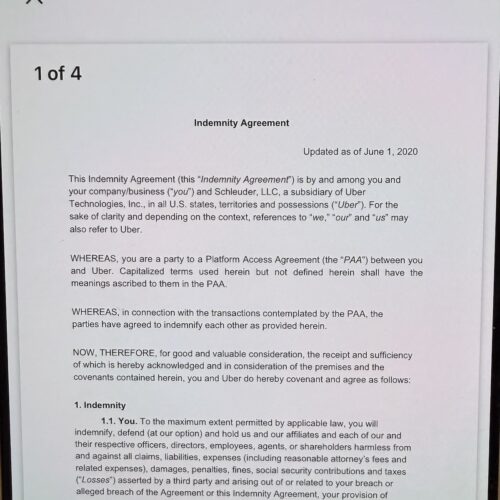
Last week, Uber drivers started reporting that they’re being asked to “Click Yes I Agree” to an Indemnity Agreement by Uber that states it was last updated in 2020.
This is yet another example of Uber shifting risk and expense associated with its business model and practices onto individual drivers while providing no information to drivers about the policy they are being asked to sign.
When drivers have a union, they get a seat at the table, instead of individually trying to figure out Uber’s or Lyft’s policy changes on their own.
What’s an “indemnification” clause, and why should you care?
An indemnity clause is a promise in a contract that one party will cover certain costs — legal defense, judgments, settlements — that arise from specific situations.
The agreement with Uber includes this paragraph:
“To the maximum extent permitted by applicable law, you will indemnify, defend (at our option) and hold us and our affiliates and each of our and their respective officers, directors, employees, agents, or shareholders harmless from and against all claims, liabilities, expenses (including reasonable attorney’s fees and related expenses), damages, penalties, fines, social security contributions and taxes (“Losses”) asserted by a third party and arising out of or related to your breach or alleged breach of the Agreement or this Indemnity Agreement, your provision of Deliveries, your access to our Platform or your interaction with any third party.”
The agreement is tied to — but legally separate from — the Platform Access Agreement (“PAA”), which is the agreement you accept to work on Uber’s platform.
You may have already signed this before but are now being asked to sign it again. Why is Uber asking drivers to sign this now?
We don’t know – and that’s a problem. If CGWU becomes the bargaining representative, Uber will have to formally share information with the union in response to questions like this, and won’t be able to change terms and conditions of work without bargaining first.
Connection to other lawsuits:
If you’ve heard about the California Attorney General and city attorneys’ case against Uber and Lyft — the one that could mean back pay for drivers who worked between 2016 and 2020 — that case and this Indemnity Agreement are separate.
Nothing in the Indemnity Agreement affects your rights in that case, waives your claims, or changes what you might be owed. The Attorney General and city attorneys’ lawsuits are about the period in time before Prop 22 passed.
Why this matters beyond the fine print:
This document was updated in 2020 and has sat there since — most drivers have never read it, and it’s written in language designed to keep it that way. It’s an example of what happens when one side has lawyers writing the rules and the other side only has an app and a click-to-agree button.
This is exactly what a union is for.
Being part of CGWU can help drivers bargain over new policies BEFORE they are sent out.
With our union, drivers will have input on and the support to interpret corporate policies and their impacts on drivers.
Join us. Sign your union card today!